




Prelims vs Mains Strategy for Government Exams
Government exam aspirants in India repeatedly struggle not because of lack of effort, but because they fail to separate their Prelims vs Mains Strategy. They prepare both stages with the same approach — same notes, same revision style, same test mindset — and then wonder why scores fluctuate.
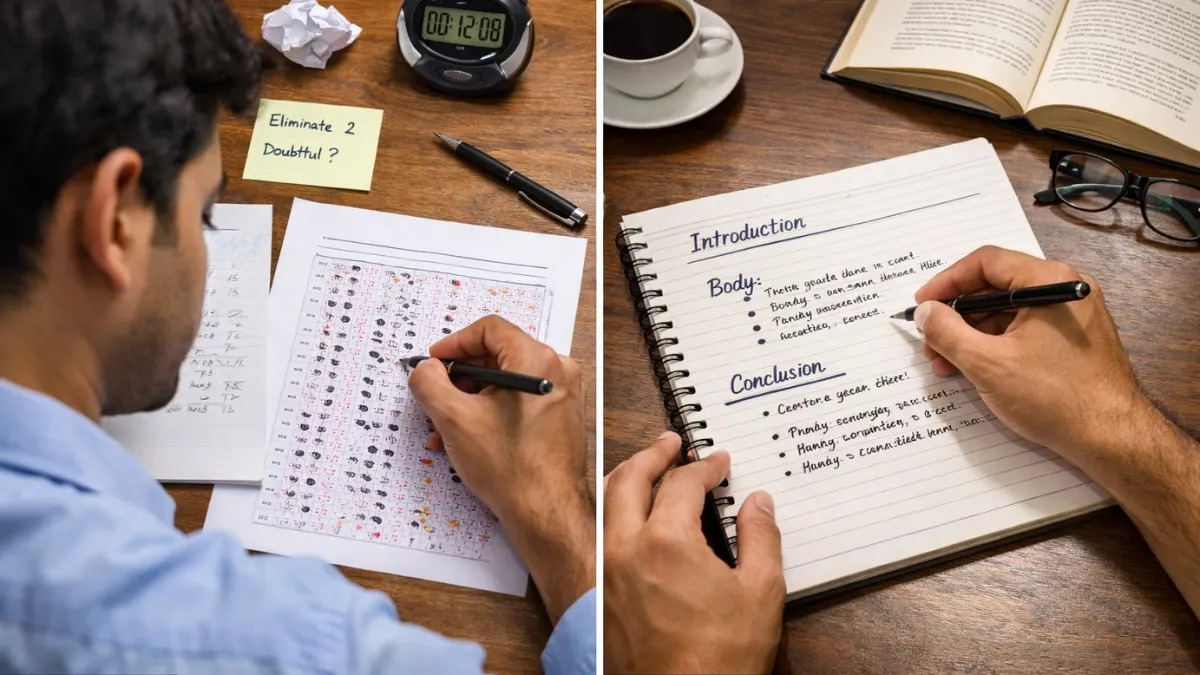
The real issue is misunderstanding the exam difference India presents between objective screening (Prelims) and descriptive evaluation (Mains). Prelims tests elimination skill, speed, and coverage. Mains tests structure, depth, articulation, and judgment.
This article provides a structured, practical breakdown of how to design and execute a high-efficiency Prelims vs Mains Strategy that improves marks in both stages without wasting preparation cycles.
Problem Statement
Most aspirants:
-
Use Mains-level notes for Prelims MCQs.
-
Prepare Prelims factual content but fail to convert it into analytical answers for Mains.
-
Shift strategy only after Prelims results.
-
Over-revise static theory but ignore answer presentation.
The consequence:
-
Narrow Prelims margins (±3–5 marks).
-
Average Mains scores despite good content knowledge.
-
Time misallocation between objective and descriptive preparation.
The root problem is not knowledge deficiency. It is structural confusion between exam formats.
Concept Clarity
What Is the Real Difference?
In India’s major exams such as UPSC Civil Services Examination, SSC CGL, and various State PSC exams:
| Parameter | Prelims | Mains |
|---|---|---|
| Nature | Objective (MCQ) | Descriptive |
| Purpose | Screening | Ranking |
| Focus | Breadth | Depth |
| Skill Tested | Elimination + recall | Analysis + articulation |
| Evaluation | Right/Wrong | Quality + Structure + Examples |
| Negative Marking | Yes (usually) | No (generally) |
This table alone explains why the Prelims vs Mains Strategy must differ.
Core Strategic Difference
Prelims Strategy
-
Maximize accuracy
-
Minimize guess risk
-
Revise short factual triggers
-
Practice elimination
Mains Strategy
-
Structure answers
-
Add dimensions
-
Use data/examples
-
Manage word limit
Preparing both stages identically reduces effectiveness.
Practical Framework
Prelims vs Mains Strategy: Step-by-Step Execution Model
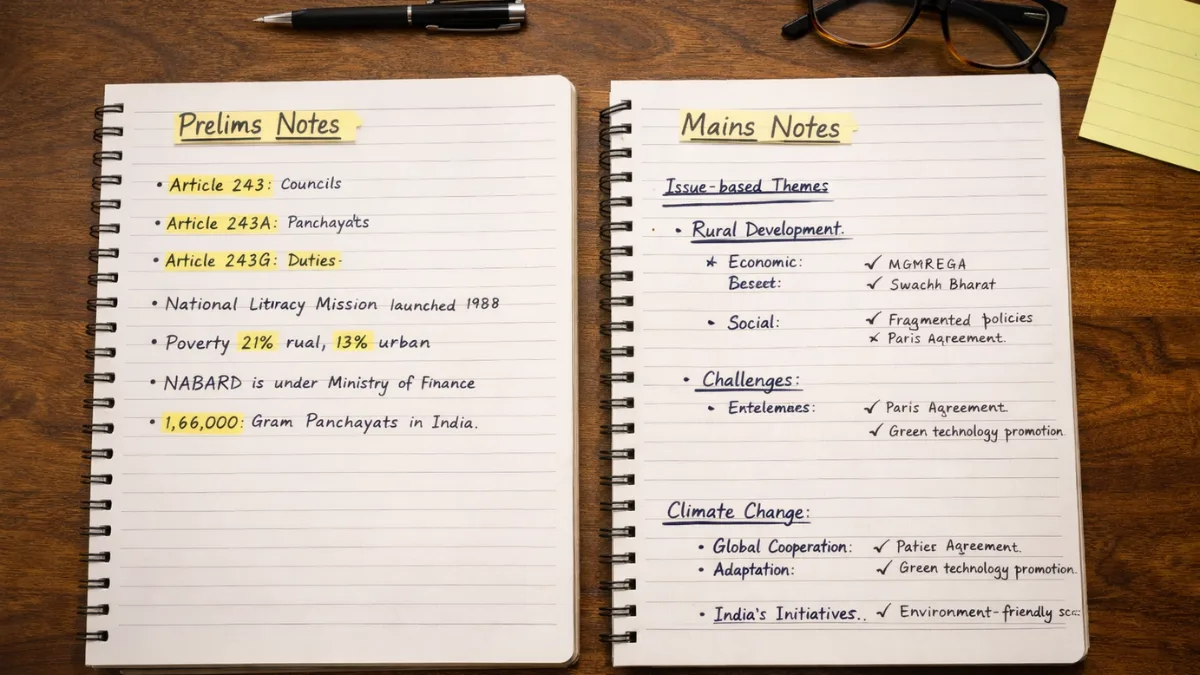
Separate Notes Physically
Do not maintain a single notebook.
Prelims Notes
-
One-page per topic
-
Bullet factual triggers
-
Dates, schemes, articles, data
Mains Notes
-
Issue-based
-
4–5 dimensions per topic
-
Examples + case studies
Reverse Preparation Model
Instead of finishing syllabus then writing answers:
-
Study topic
-
Attempt 15–20 MCQs
-
Write 1 short Mains answer
-
Identify gap
This ensures dual-stage readiness.
Question Approach Difference
Prelims Approach Example
Question:
Which of the following are Fundamental Duties?
Correct Strategy:
-
Eliminate extreme options.
-
Recall keyword triggers.
-
Avoid overthinking.
Mains Approach Example
Question:
Discuss the role of Fundamental Duties in strengthening democracy.
Correct Strategy:
-
Define briefly
-
Add constitutional reference
-
Provide dimensions (legal, civic, moral)
-
Conclude with reform suggestion
Model Answer Snippet (Short Format)
Question:
“Discuss the role of local governance in rural development.”
Answer Structure:
Introduction (2 lines):
Local governance institutions such as Panchayats form the grassroots implementation mechanism for rural development policies.
Body:
-
Decentralized planning improves need-based allocation.
-
Social audit increases accountability.
-
Convergence of schemes enhances efficiency.
-
Community participation ensures sustainability.
Conclusion:
Strengthening fiscal autonomy and digital monitoring can enhance effectiveness.
This structure is irrelevant for Prelims but essential for Mains.
Mistake vs Correct Approach Comparison
| Mistake | Correct Approach |
|---|---|
| Reading textbooks repeatedly | Solve sectional MCQs weekly |
| Writing long answers | Structured 150/250 word format |
| Ignoring PYQs | Analyze 10-year trend |
| Postponing answer writing | Start after 3 months preparation |
Common Errors
1. Over-Emphasis on Static Theory
Aspirants memorize entire chapters but fail to convert information into:
-
Option elimination logic (Prelims)
-
Analytical points (Mains)
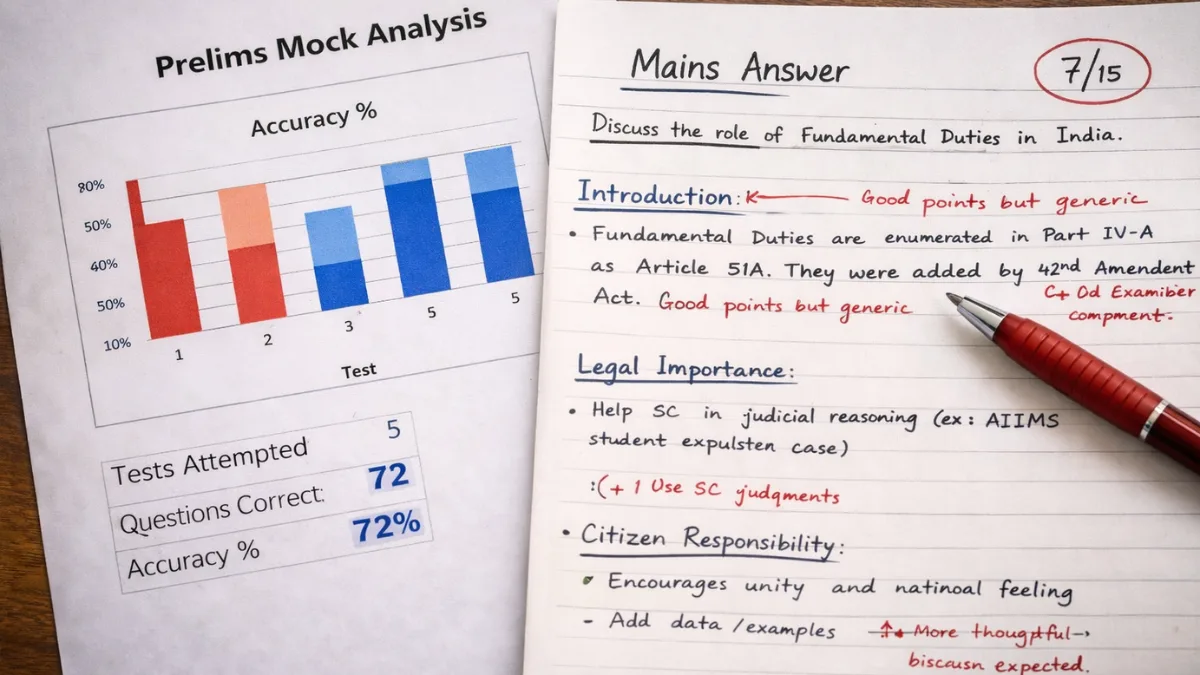
2. No Accuracy Tracking
For Prelims:
Not tracking:
-
Attempt number
-
Accuracy %
-
Negative marking loss
Without tracking, improvement stalls.
3. Writing Mains Answers Without Framework
Common issues:
-
No headings
-
No introduction
-
No conclusion
-
Repetition of textbook content
Examiners reward structure, not length.
4. Ignoring Exam Difference India Creates
Many aspirants preparing for IBPS PO Exam or State PSC exams treat Prelims as just another mock phase. But in competitive pools, cut-offs fluctuate heavily. Strategy must adapt accordingly.
5. Late Transition to Mains Preparation
Waiting for Prelims result to start Mains prep:
-
Reduces writing practice
-
Causes content underdevelopment
-
Leads to rushed revision
Tactical Application: How This Improves Marks
In Prelims
-
5% accuracy improvement = +6 to +10 marks
-
Better elimination reduces negative marking
-
Clear revision sheets improve recall speed
In Mains
-
Structured answers increase evaluator clarity
-
Headings improve readability
-
Adding examples increases content richness
-
Balanced conclusions create impression of maturity
In descriptive exams, presentation alone can shift marks from 90 to 120 in a paper.
Improvement Plan
Daily Plan (Integrated Model)
Morning (2 hours):
-
Study one static topic
-
Prepare Prelims bullet sheet
Afternoon (1 hour):
-
Solve 25 MCQs
-
Track accuracy
Evening (1 hour):
-
Write 1 Mains answer
-
Review with model structure
Weekly Plan
Sunday Review System
-
Analyze 200 MCQs attempted.
-
Identify weak areas.
-
Rewrite 5 weak Mains answers.
-
Update examples and data.
-
Revise Prelims rapid notes.
Monthly Milestone
-
1 full Prelims mock (timed)
-
1 sectional Mains test
-
Evaluate improvement metrics
Metrics to track:
| Metric | Target |
|---|---|
| Prelims Accuracy | 70%+ |
| Negative Marking | <15% |
| Mains Word Limit Adherence | 90% |
| Intro + Conclusion Quality | Consistent |
Internal Link Placeholders
Advanced Layer: Converting Prelims Content into Mains Value
Example:
Prelims Fact:
Article 243 deals with Panchayats.
Mains Conversion:
-
Constitutional backing (243–243O)
-
73rd Amendment significance
-
Fiscal decentralization
-
Challenges (funding, capacity, state interference)
This conversion skill differentiates rankers.
Exam Difference India: Why It Matters
India’s government exam ecosystem is layered:
-
Central exams
-
State PSCs
-
Banking sector
-
SSC
Despite variation, screening and ranking pattern remains consistent. Understanding the exam difference India imposes between stages allows you to:
-
Design note hierarchy
-
Optimize revision
-
Avoid duplication
-
Reduce burnout
Final Execution Checklist
Before Prelims:
-
8–10 full mocks
-
3 revisions of rapid sheets
-
Weak area elimination practice
Before Mains:
-
50–80 answers written
-
10 essays practiced (if applicable)
-
3 revisions of issue-based notes
[ruby_related heading=”More Read” total=5 layout=1 offset=5]
Conclusion
A serious aspirant must treat Prelims vs Mains Strategy as two coordinated but distinct preparation tracks. Prelims rewards accuracy and elimination skill. Mains rewards structure and articulation. Confusing these formats leads to inefficient preparation and marginal scores.
Understanding the exam difference India creates between objective screening and descriptive ranking allows aspirants to allocate time, notes, and revision intelligently.
A well-designed Prelims vs Mains Strategy is not about studying more. It is about aligning preparation method with evaluation mechanism.