







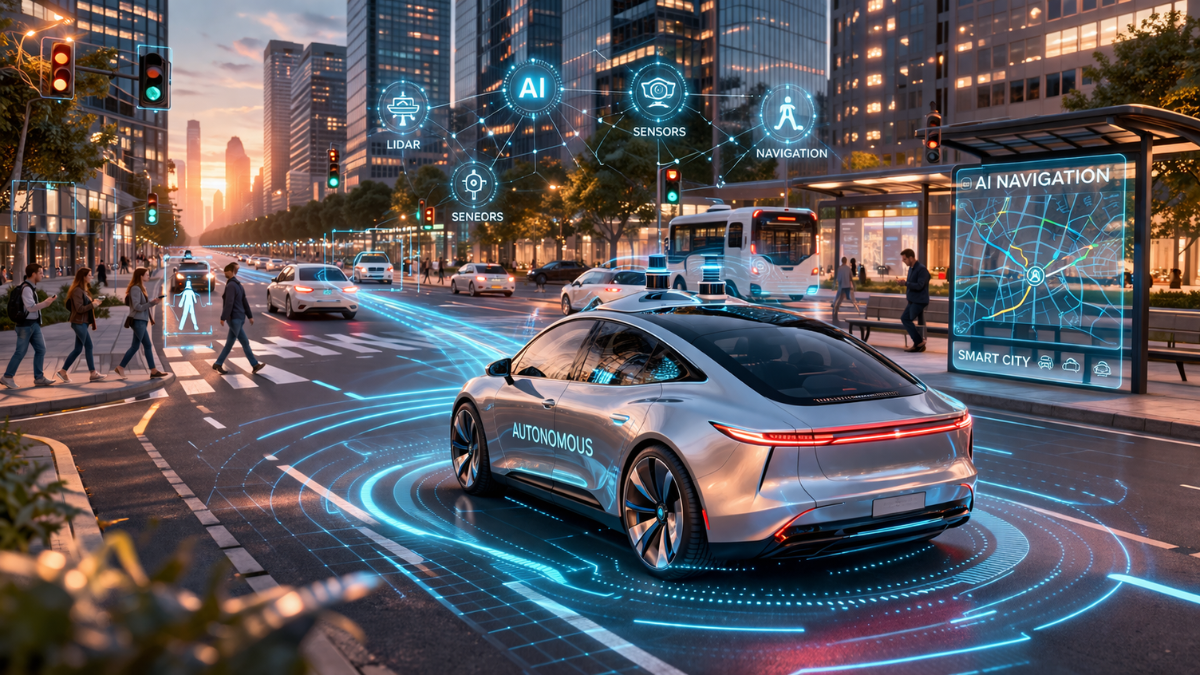
The traffic light turns green, but no one presses the accelerator.
The car moves anyway.
No hesitation, no distraction, no human error—just a smooth, calculated glide through the intersection. Inside, the passenger scrolls through emails, barely noticing the complexity unfolding beneath them. Sensors scan the road. Algorithms predict behavior. Decisions happen in milliseconds.
This is not a futuristic concept anymore. It’s already here, quietly integrating itself into everyday life.
Understanding What Is Autonomous Vehicles? is no longer a niche curiosity—it’s becoming essential to understanding how cities, economies, and even human behavior are evolving.
What Is Autonomous Vehicles? A Clear Explanation
At its core, autonomous vehicles are machines designed to drive themselves without human intervention. They rely on a combination of technologies—artificial intelligence, sensors, cameras, radar, and real-time data processing—to interpret surroundings and make driving decisions.
But that definition feels too simple for something this complex.
A better way to think about it: autonomous vehicles are decision-making systems on wheels. They don’t just move—they observe, predict, and react.
Companies like Tesla, Waymo, and Uber have spent years building vehicles that can handle everything from highway cruising to navigating crowded city streets.
Yet, not all “self-driving” cars are fully autonomous. The industry actually operates on levels—from basic driver assistance to full automation where human involvement disappears entirely.
And we’re still somewhere in the middle.
From Cruise Control to Intelligence: How It All Started
The journey didn’t begin with futuristic AI labs. It began with something far more ordinary—cruise control.
Over decades, cars evolved from simple mechanical systems to software-driven machines. Features like lane assist, adaptive braking, and parking sensors slowly trained drivers to trust automation.
Then came a shift.
Instead of assisting humans, technology began replacing them.
Projects funded by organizations like DARPA in the early 2000s accelerated development. Autonomous vehicle competitions proved that machines could navigate real-world environments with surprising accuracy.
What started as experiments turned into billion-dollar industries.
Why “What Is Autonomous Vehicles?” Is Trending Right Now
The surge in interest isn’t accidental. It’s driven by three converging realities.
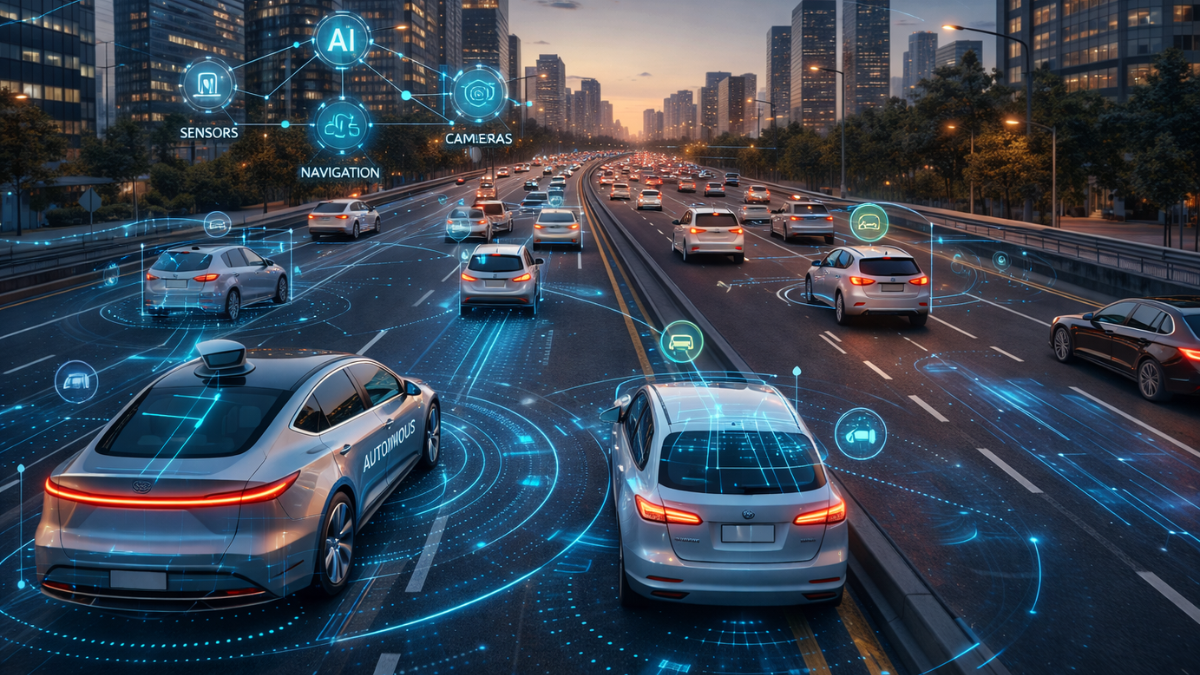
First, urban congestion is reaching unsustainable levels. Cities are expanding faster than infrastructure can keep up. Autonomous vehicles promise efficiency—less traffic, smarter routes, reduced idle time.
Second, safety. Human error causes the majority of road accidents. Fatigue, distraction, poor judgment—these are human problems. Autonomous systems aim to eliminate them.
Third, economics.
Transportation is not just movement—it’s a massive industry. Logistics, ride-sharing, delivery networks—automation has the potential to reshape entire business models. A driverless delivery system, for example, doesn’t sleep, doesn’t demand wages, and operates continuously.
That changes everything.
How Autonomous Vehicles Actually “Think”
To understand autonomous vehicles, you have to understand how they perceive the world.
These vehicles combine multiple layers of intelligence:
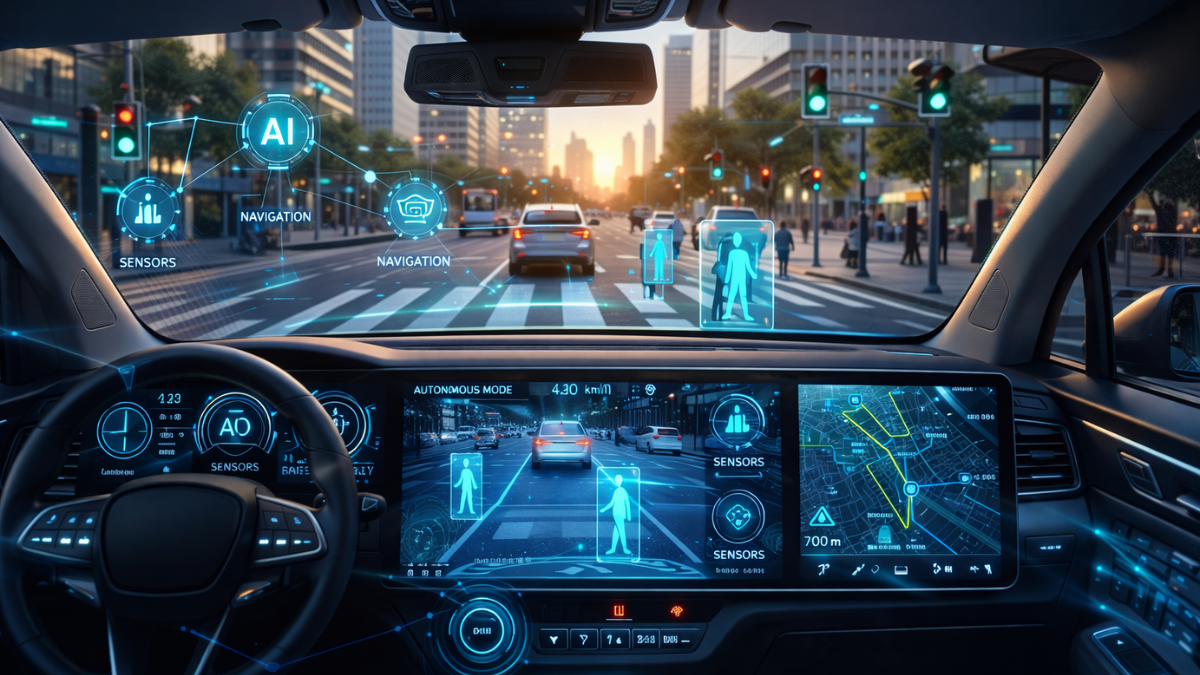
- Perception: Cameras and sensors identify objects—cars, pedestrians, signals.
- Prediction: The system anticipates what those objects might do next.
- Decision-making: Algorithms choose the safest and most efficient action.
- Execution: The car accelerates, brakes, or turns accordingly.
Unlike humans, who rely on intuition, machines rely on probability.
They don’t “guess.” They calculate.
And that’s both their greatest strength—and their biggest limitation.
The Psychological Shift: Trusting Machines With Control
Here’s where things get interesting.
The biggest barrier to autonomous vehicles isn’t technology—it’s trust.
Humans are used to being in control. Handing over that control to a machine feels unnatural, even when statistics suggest it might be safer.
There’s a paradox at play:
- People fear rare machine errors more than frequent human mistakes
- One autonomous vehicle accident gets global attention
- Thousands of daily human-driven accidents go unnoticed
Trust isn’t built on logic. It’s built on perception.
And perception takes time to change.
Business and Industry: The Silent Transformation
Autonomous vehicles are not just about transportation—they’re about restructuring industries.
Consider logistics. Companies are already experimenting with driverless trucks for long-haul routes. The impact? Lower costs, faster delivery cycles, and continuous operations.
Ride-sharing platforms are watching closely. If drivers are removed, profit margins shift dramatically.
Insurance companies face a different challenge. If accidents reduce, traditional models of risk and premiums will need to be redefined.
Even urban planning will change.
Parking spaces may become less necessary. Roads may become narrower. Cities could be designed for flow, not congestion.
This isn’t a technological upgrade. It’s a systemic transformation.
The Challenges No One Talks About Enough
Despite the optimism, the road ahead isn’t smooth.
Autonomous vehicles struggle with unpredictability—construction zones, unusual weather, human behavior that doesn’t follow patterns.
Ethical dilemmas also remain unresolved. In unavoidable accident scenarios, how should a machine decide?
Legal frameworks lag behind innovation. Who is responsible in case of failure—the manufacturer, the software developer, or the owner?
And then there’s infrastructure. Not every region is ready for autonomous integration. Road conditions, connectivity, and regulation vary widely.
Technology is advancing faster than systems designed to support it.
What Is Autonomous Vehicles? And What Comes Next
The next phase of autonomous vehicles won’t be about perfection—it will be about coexistence.
Human-driven and machine-driven vehicles will share roads for years. Hybrid systems will dominate before full autonomy becomes mainstream.
We’ll likely see:
- Autonomous delivery fleets in controlled zones
- Self-driving taxis in urban areas
- Advanced driver-assistance becoming standard in personal cars
Full autonomy everywhere? That’s still a longer journey.
But the direction is clear.
[ruby_related heading=”More Read” total=5 layout=1 offset=5]
Conclusion: The Road Is No Longer Just Physical
Understanding What Is Autonomous Vehicles? is really about understanding a deeper shift.
Driving used to be a skill. Then it became a routine. Now, it’s becoming optional.
What’s unfolding isn’t just a change in how we travel—it’s a change in how decisions are made. Machines are beginning to take over tasks that once required human judgment.
And once that shift happens in one domain, it rarely stays there.
Final Insight
The future of mobility will not be defined by how fast cars can move, but by how intelligently they can decide. Autonomous vehicles are not just reshaping roads—they are quietly redefining control itself. Stay ahead of these transformations with The Vue Times, where technology is not just explained, but understood.
Frequently Asked Questions
What is autonomous vehicles in simple terms?
Autonomous vehicles are cars that can drive themselves using AI, sensors, and software without needing a human driver to control them.
Are autonomous vehicles fully safe?
They are designed to reduce human errors, but they are not completely risk-free. Challenges like unpredictable situations and system limitations still exist.
How do autonomous vehicles work?
They use cameras, sensors, radar, and AI algorithms to detect surroundings, predict movement, and make driving decisions in real time.
What are the levels of autonomous driving?
There are six levels (0–5), ranging from no automation to full self-driving where no human input is needed at all.
Will autonomous vehicles replace human drivers?
Not immediately. Human and autonomous vehicles will coexist for years before full automation becomes widespread.