







In descriptive government examinations, marks are rarely lost because students lack information. They are struggling because the answers aren’t structured according to the evaluation expectations. The difference between an average and a high-scoring response is usually structural clarity.
The 20 Mark Answer Structure is not about writing more content. It is about presenting content in a format that examiners can assess quickly, logically, and confidently. Most aspirants prepare content but neglect the mains answer format required to convert knowledge into marks.
This article explains how to structure 10 and 20-mark answers in a way that improves scoring efficiency without increasing writing volume.

Problem Statement
Many students tend to struggle with three common structural problems when writing their answers:
- Writing very long paragraphs without breaks.
- Spending way too much time on their introductions.
- Not dividing their answers up properly according to the question’s requirements.
This is especially important for 10-mark and 20-mark questions because how you structure your answer really affects how quickly the examiner can grade it. Examiners have to get through hundreds of papers in a limited amount of time, and they simply don’t have the time to hunt for good points hidden deep inside dense blocks of text.
Some typical mistakes students make include:
- Writing way too much for a 10-mark question – like filling up three pages.
- Just giving definitions without actually answering what the question is asking for.
- Missing out on parts of the question.
- Not balancing their answer (like only talking about the positives and ignoring the negatives, or vice versa).
It’s quite common for students to really understand the topic, but then fail to show that understanding clearly in the format required for the main exam answers.”
Concept Clarity
What Is the 20 Mark Answer Structure?
The 20 Mark Answer Structure is a predefined logical layout that ensures:
- Clear introduction
- Demand-oriented body
- Organized subheadings
- Balanced arguments
- Brief but strong conclusion
It applies differently to 10 and 20 mark answers due to space and depth variation.
Structural Difference: 10 vs 20 Marks
| Component | 10 Marks | 20 Marks |
| Word Limit | ~150–200 words | ~250–300 words |
| Depth | Basic analysis | Multi-dimensional analysis |
| Subheadings | 2–3 | 4–6 |
| Examples | 1 short | 2–3 brief |
| Conclusion | 1–2 lines | 2–3 lines |
In descriptive exams like Union Public Service Commission and various state PSCs, evaluation is structured and time-bound. Answers are assessed for:
- Relevance
- Clarity
- Coverage
- Logical flow
- Proportionality
Structure directly influences all five.
Practical Framework
Step-by-Step Approach
Decode the Directive
Identify whether the question says:
- Discuss
- Examine
- Analyse
- Critically evaluate
Each directive determines structure depth.
Example:
“Discuss the challenges in implementation of welfare schemes in India.”
Directive: Discuss → Provide multiple dimensions + explanation.
Write a Functional Introduction (2–3 lines)
Avoid philosophical openings.
Correct introduction format:
- Define the concept briefly
- Provide context
- Link to question demand
Example:
“Welfare schemes in India aim to ensure social security and inclusive development. However, implementation challenges often reduce their intended impact.”
Structured Body (Core of 20 Mark Answer Structure)
For 10 marks:
- 3–4 subheadings
- Crisp explanation
- No over-elaboration
For 20 marks:
- 4–6 dimensions
- Balanced coverage
- Use bullet points where possible
Example body structure for 20 marks:
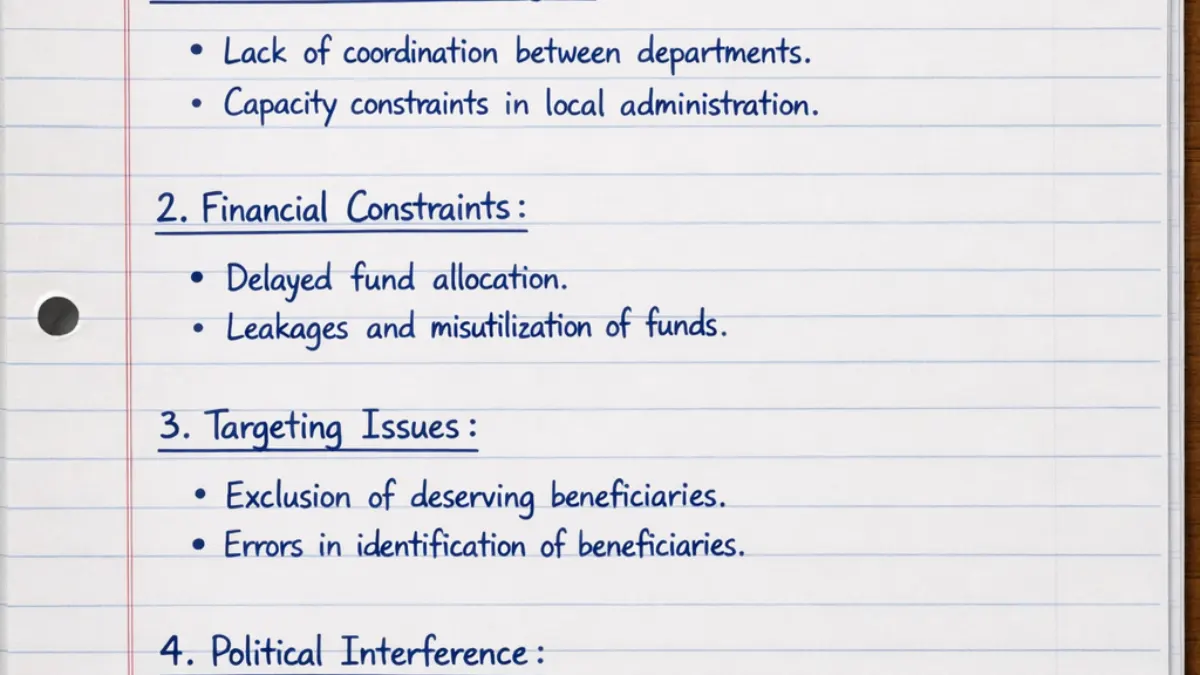
Administrative Challenges
- Lack of coordination
- Capacity gaps
Financial Constraints
- Delayed fund release
- Leakages
Targeting Issues
- Inclusion and exclusion errors
Political Interference
- Scheme distortion
Monitoring Weakness
- Poor data tracking
Add Example or Data (Short, Relevant)
Example:
“According to CAG observations, fund utilization inefficiencies have affected multiple welfare schemes.”
No unnecessary statistics.
Balanced Conclusion (2–3 lines)
- Reform-oriented
- Forward-looking
- Connected to demand
Example:
“Strengthening administrative capacity and improving monitoring mechanisms are essential to enhance welfare scheme effectiveness.”
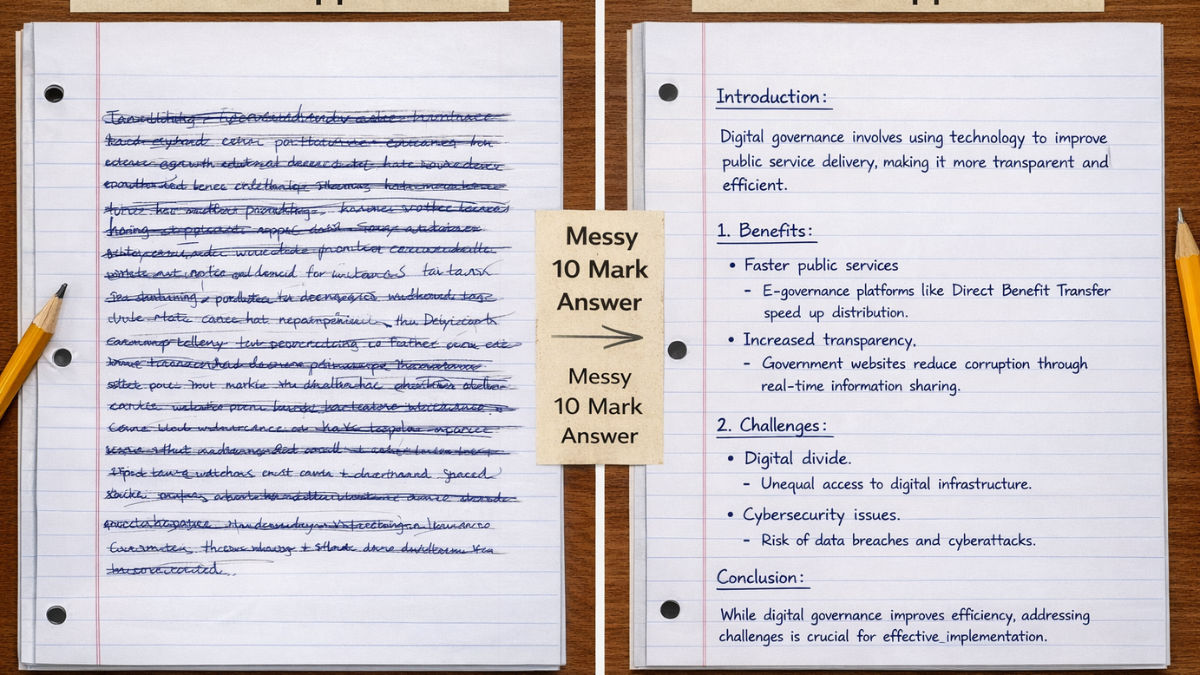
Model Answer Snippet (Short Format – 10 Marks)
Question: Examine the role of digital governance in improving public service delivery.
Introduction:
Digital governance refers to the use of technology to enhance transparency, efficiency, and accessibility in public administration.
Body:
Improved Transparency
- Online portals reduce corruption.
Faster Service Delivery
- Direct Benefit Transfer ensures timely payments.
Better Accountability
- Real-time tracking systems.
Challenges
- Digital divide
- Cybersecurity concerns
Conclusion:
While digital governance enhances efficiency, bridging access gaps remains essential.
This is a correct mains answer format for a 10 mark question.
Mistake vs Correct Approach Comparison
| Mistake | Correct Approach |
| Writing essay-style paragraphs | Use structured subheadings |
| Ignoring question directive | Align structure with directive |
| No conclusion | Always close logically |
| Overwriting introduction | Limit to 2–3 lines |
| One-dimensional answer | Provide 3–5 dimensions |
Common Errors
Content Dumping
Students write everything they know. This reduces clarity.
Correction: Select only demand-relevant points.
Lack of Proportion
Spending half page on introduction.
Correction: Introduction ≤ 10% of answer.
No Visual Structure
Dense blocks reduce examiner comfort.
Correction:
- Use subheadings
- Maintain spacing
- Underline key terms (if permitted)
Ignoring Balance
Writing only positives or only negatives.
Correction: Always show analytical balance.
Weak Conclusions
Ending abruptly without summary.
Correction: Conclude with solution, reform, or future direction.
Tactical Application
How does structured writing increase marks?
Improves Examiner EfficiencyfF
A clear 20 Mark Answer Structure helps the examiner identify:
- Coverage
- Analytical depth
- Relevance
Ensures Complete Attempt
Structured answers reduce chances of missing dimensions.F
Saves Time
Predefined structure reduces thinking time during exam.
Enhances Analytical Impression
Multi-dimensional presentation reflects maturity.
Aligns With Evaluation Pattern
In descriptive examinations like those conducted by Staff Selection Commission and various state public service commissions, evaluation sheets are designed to check structured components.
Improvement Plan
Structure is not built during exam. It is trained before exam.
Daily Practice (30–45 Minutes)
- Pick one previous year question.
- Spend 5 minutes on structure only.
- Write headings first.
- Then fill content.
- Review proportion.
Weekly Practice Plan
Day 1–2: 10 mark questions
Day 3–4: 20 mark questions
Day 5: Review weak areas
Day 6: Rewrite one answer
Day 7: Analyse improvements
Structured Practice Template
Use this layout during practice:
Introduction (2–3 lines)
Dimension 1
Dimension 2
Dimension 3
Dimension 4 (if 20 marks)
Example/Data
Conclusion
Self-Assessment Checklist
Before finishing answer, ask:
- Did I address directive?
- Is structure visible?
- Are points balanced?
- Is conclusion present?
- Is answer proportional to marks?
(For Deeper Strategy Reading)
- [Why Structure Matters More Than Content in Mains Answers]
- [Common Government Exam Mistakes That Reduce Marks]
- [Answer Writing Strategy for Competitive Exams]
[ruby_related heading=”More Read” total=5 layout=1 offset=5]
Conclusion
Scoring top marks in descriptive government exams isn’t really about packing in tons of extra information. It’s all about being clear, well-organized, and presenting your thoughts in a structured way.
The “20 Mark Answer Structure” is a great tool because it helps keep your answers focused, analytical, and easy for the examiner to follow. Whether you’re writing a response worth 10 marks or 20, your answers should always include:
- A clear introduction to set the stage.
- Well-organized points covering different aspects.
- Balanced arguments that consider multiple sides.
- A brief conclusion to wrap things up.
Aspiring candidates who really work on improving their answer structure make it much easier for their efforts to be noticed and avoid losing points for small mistakes.
In government exams, how you present your answers isn’t just about looking good—it actually matters in the evaluation process. Getting really good at the 20 Mark Answer Structure helps turn all your hard work studying into actual marks on your scorecard.