












India’s digital economy is evolving at a rapid pace in 2025. From street vendors to corporate giants, everyone is going cashless. But now, there’s a new player in the digital payment space: the Digital Rupee (e₹). Many Indians are wondering — “What’s the difference between Digital Rupee and UPI?” and “Which one should I use?”
This blog breaks down everything you need to know about Digital Rupee vs. UPI in simple terms.
What is UPI? (Unified Payments Interface)
Launched in 2016 by the National Payments Corporation of India (NPCI), UPI is a real-time payment system that enables users to transfer money between bank accounts instantly using their smartphones.
Key Features of UPI:
-
Instant money transfer via mobile apps like PhonePe, Google Pay, Paytm, BHIM, etc.
-
Linked directly to your bank account
-
Free or very low transaction fees
-
Supports QR code payments, recurring payments, and even IPO applications
What is the Digital Rupee (e₹)?
Introduced by the Reserve Bank of India (RBI), the Digital Rupee (e₹) is India’s official Central Bank Digital Currency (CBDC). Unlike UPI, it is legal tender issued directly by the RBI, just like physical cash but in digital form.
Key Features of Digital Rupee:
-
Issued and controlled by RBI
-
Can be stored in CBDC wallets, not bank accounts
-
Accepted as legal tender like physical cash
-
Can be used offline in some pilot areas
-
Comes in two types:
- Retail CBDC (e₹-R) – for individuals
- Wholesale CBDC (e₹-W) – for banks and institutions
Digital Rupee vs. UPI: Key Differences (2025 Updated)
| Feature | UPI | Digital Rupee |
|---|---|---|
| Issuer | Your bank | Reserve Bank of India |
| Form | Bank-to-bank transaction | Digital version of physical cash |
| Account Required? | Yes | No (wallet-based) |
| Legal Tender? | No | Yes |
| Offline Use? | No | Limited pilot (yes) |
| Anonymity | Linked to bank & mobile number | More cash-like, but traceable by RBI |
| Use Cases | Peer-to-peer payments, e-commerce | Cash replacement, government subsidies, secure payments |
Why Did RBI Launch the Digital Rupee?
The RBI launched the Digital Rupee to:
-
Reduce the cost of cash handling
-
Boost financial inclusion
-
Strengthen digital sovereignty
-
Enhance payment security and traceability
-
Prepare India for a cash-lite economy
Pros and Cons: Digital Rupee vs. UPI
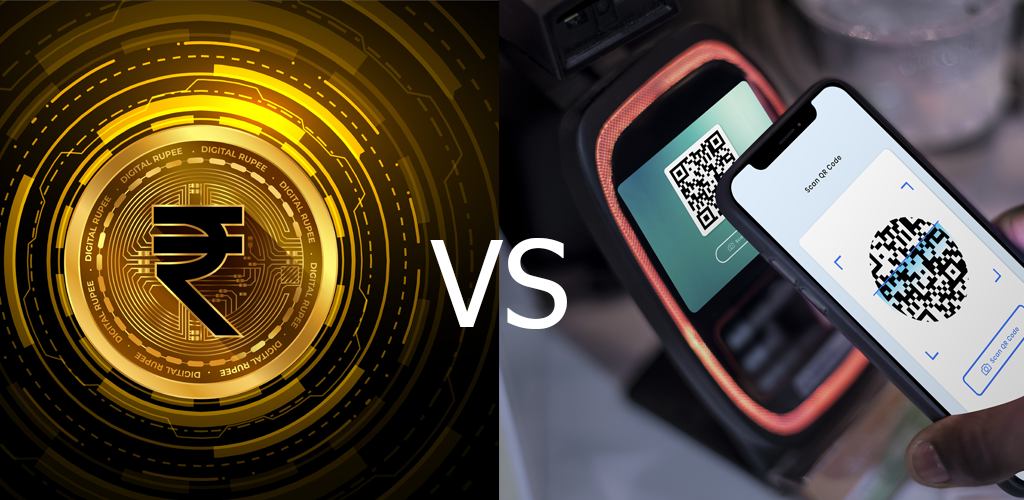
Advantages of Digital Rupee
-
More secure (issued by RBI)
-
Legal tender
-
Potential for offline transactions
-
May reduce reliance on intermediaries (banks/apps)
[ruby_related heading=”More Read” total=5 layout=1 offset=5]
Limitations of Digital Rupee
-
Limited adoption as of 2025
-
Usability still evolving
-
Fewer merchant integrations compared to UPI
Advantages of UPI
-
Extremely user-friendly
-
Widely accepted across India
-
Fast and reliable
-
Integrated into most mobile banking apps
Limitations of UPI
-
Requires a bank account and internet
-
Heavily dependent on private apps and banks
Which One Should You Use in 2025?
| Use Case | Recommended |
|---|---|
| Everyday digital payments | UPI |
| Offline or cashless backup | Digital Rupee |
| Government subsidy or aid transfers | Digital Rupee |
| Privacy-conscious transactions | Digital Rupee (limited) |
| Business and high-value banking | Both |
Use UPI for convenience and speed, and Digital Rupee for cash-replacement and secure offline use.
The Future of Digital Payments in India
By 2025, India is moving toward multi-layered digital payments, where both UPI and Digital Rupee will co-exist, offering users more choices and security.

With continuous innovations, expect:
-
Wider offline CBDC support
-
Integration of Digital Rupee into UPI apps
-
More government initiatives using e₹ for direct benefit transfers (DBT)