







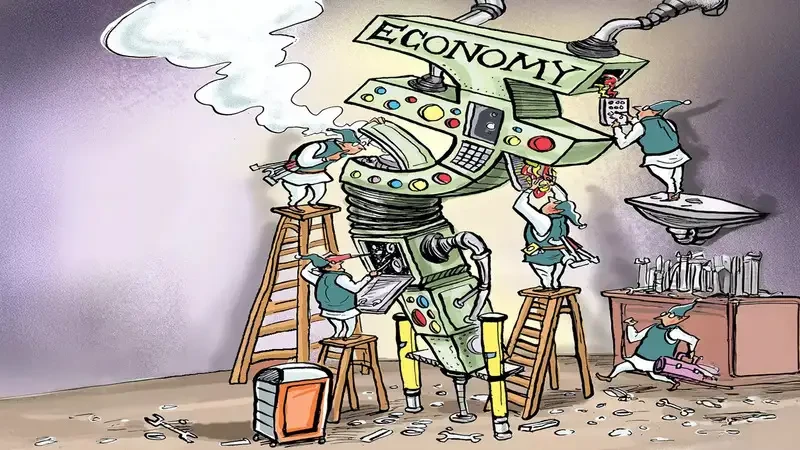
A Nation’s Mirror Moment
India has always boasted of being the largest representative democracy in the world, a growing economic powerhouse and a country with an unassailable moral and cultural conscience. In recent years though these three pillars, namely, democracy, economy and conscience have been acting strained, as never before. The headlines are no longer just a piece of flowery speech, but are also a piece of day to day common talk.
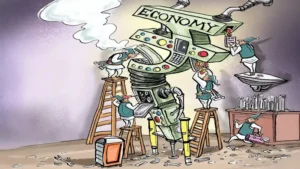
The provocation is obvious: Do we witness the gradual murder of the democratic intentions? Is our economy a patient on life support in ICU, with government wishful thinking and biased statistics keeping our economy on life support? Or has it been even deeper-rooted, even more alarming a deadening of our collective awareness?
These questions are explored in detail in this article with The Vue Times, but the reality is dissected back to the possibilities of renewal. It is not an obituary; rather a long glance in the mirror.
Democracy on Life Support?
1. Historical Anchors: From Republic to Reality
The path of democracy in India started in 1950 when Indians had a Constitution that assured them justice, liberty, equality, and fraternity. The first few decades experienced lively arguments, giants of leadership, and institutional regard. Nevertheless, the democracy in India has never been stress-free. We have witnessed Emergency (1975-77), regional nasalism and vagrancy along caste lines. The only distinction now is that the erosion, should it occur, comes in a more subtle, legalistic and electorally legitimate manner.
2. Signs of Decline — Measured and Felt
- Slipping in Global Rankings
India has been demoted by the V-Dem Institute to “electoral autocracy.” Freedom House has since dubbed it partly free. Its classification is ranked by the Economist Intelligence Unit as a flawed democracy. These are not fringe voices; they are founded on sets of data counting press freedom, judicial independence and election fairness. - Institutional Fatigue
The Supreme Court and Election Commission which used to be beacons of confidence in the people are now being accused of selective activism and tardiness of justice. Such agencies as CBI and ED have gone through criticism of targeting political rivals more forcefully as compared to political affinity. - Press Under Pressure
The press has to deal with the direct censorship in some afternoon raids on media houses all the way up to indirect censorship through critical advertisement withdrawals. In 2024, India came 16th place out of the 180 nations in the World Press Freedom Index, a very sharp decline by a nation boasting of open debate. - Shrinking Space for Dissent
Efforts to dub student leaders, activists, even comedians with sedition or UAPA charges have not been uncommon. Freedom of protesting, as established in Article 19 is becoming a contingent act, being guarded by permits and police obstacles.
3. Why It Matters
Democracy will not just mean elections every five years, but a concerted flow of power all the time. The checks weaken when power is concentrated whether in the executive, in a one-party state, or in a personality cult. That is when democracy starts to look like itself, which it detested in the first place.
4. The Flip Side — Reasons for Hope
Although the picture of decline reads well there is strength:
- Turnout is quite high, particularly in the case of women and first-time voters.
- Federalism has survived because regional parties still win major elections in states.
- Although this has occurred selectively, judicial interventions have eliminated unconstitutional actions.
- Farmers protests, the green movements: This shows that the people are not an inert mass.
Economy: Growth or ICU Care?
- The Numbers Game
India has a GDP growth rate of 6-6.5% anticipated by the government within a span of FY 2025-26, which is why it is one of the fastest-growing large economies. On paper, this is a dream come true. Probe a little deeper, however, and inconsistencies arrive:
- This is very close to CMIE recorded youth unemployment rates of 17-18%.
- The distress of the informal sector remains post-COVID where MSMEs have difficulties accessing credit.
- There has been increased wealth inequality: the richest 10% possess more than 77% of the national wealth.
2. Structural Challenges
- Excessive reliance on Services
The manufacturing contribution to GDP is not growing beyond that of 15-16%, thereby restricting the creation of employment.
- Agricultural Insecurity
India is a country where agriculture absorbs about 45% of the workforce yet less than 18% of the GDP. Indonesia: A sector like this is vulnerable to climatic shocks, erratic monsoons and market fluctuations.
- International Headwinds
An increase in tariffs imposed by key trading partners (such as the U.S. as part of the 2025 policy by Trump) and the presence of recessionary global trends is a threat to exports in the textile sector, IT services, and auto components.
3. The Positives — And They Are Real
Notwithstanding these difficulties:
- Digital India has also integrated 500 million people into the banking system.
- The 12 billion UPI transactions per month shows the deep penetration into the digital.
- The buildout of infrastructure projects such as highways, ports, renewable energy is still at record pace.
- India continues to be one of the leading destinations of foreign investment particularly in tech and manufacturing decentralization out of China.
Conscience: The Silent Crisis
- What is the National Conscience?
Conscience, in this case, refers to the moral compass of the nation as a whole -the capacity to make the distinction between right and wrong over and above law and profitability. Historically, this was influenced by such leaders as Gandhi, Ambedkar and Nehru, and by movements that championed justice and equality.
- Morhanup Melaya/ Moral Fatigue Symptoms
- Communal Polarization: Hate crimes, religious intolerance have been on the rise and the political rhetoric tends to exacerbate the divisions.
- Viral scandals: People forget within days, a new entertainment piece dominates the Twittersphere.
- Normalization of Corruption: Electronic bonds, political money-raising that do not allow access to information impair the correlation between integrity and public service.
- Flames of Opposition
It is not entirely lost:
- The toppling of the unconstitutional electoral funding legislation by the Supreme Court.
- People protesting over catastrophe relief or social concerns.
- Climate movements of youths bringing unsustainable projects to question.
- These demonstrate that the conscience is bruised, not beaten.
Pros and Cons in Depth
Democracy
Pros:
- Exuberant voting turnout
- The protection granted by the constitution remains there.
- High level of active civil society movements
Cons:
- Cripple of institutional independence
- Undermining the freedom of press
- Restriction of disagreement
Economy
Pros:
- High rates of GDP growth
- Digital and infrastructure growth
- Healthy influx of foreign investment
Cons:
- Persistent unemployment
- Inequality widening
- Exposure to international shocks in trade
Conscience
Pros:
- Moral traditions that continue to survive are historic
- A live grassroots activism
- Increasingly rights conscious youth
Cons:
- Religious polarization
- The indifference of people to the injustice of the system
- Monetization of politics in morality
Pathways to Renewal
- Strengthening Institutions
Ensure independence of investigative agencies at full and restore credibility in courts and the neutrality of the Election Commission.
- Inclusive Economic Policies
Emphasis on labor-intensive production, farm modernization and on MSMEs.
- Civic Education
Introduce constitutional literacy learning in school curriculum, which will help towards responsible citizenship.
- Media Reform
Establish legal protection and funding free of government control.
Conclusion — Not Dying, but Demanding
The democracy of India is strained, its economy is crippled in certain areas, and its conscience has ineluctable moments of silence. However, this is not the fatal diagnosis. It is a call to vigilance, action, and ethical braveness.
The question should not be will these pillars survive, but will we as citizens take them with the seriousness they demand.