







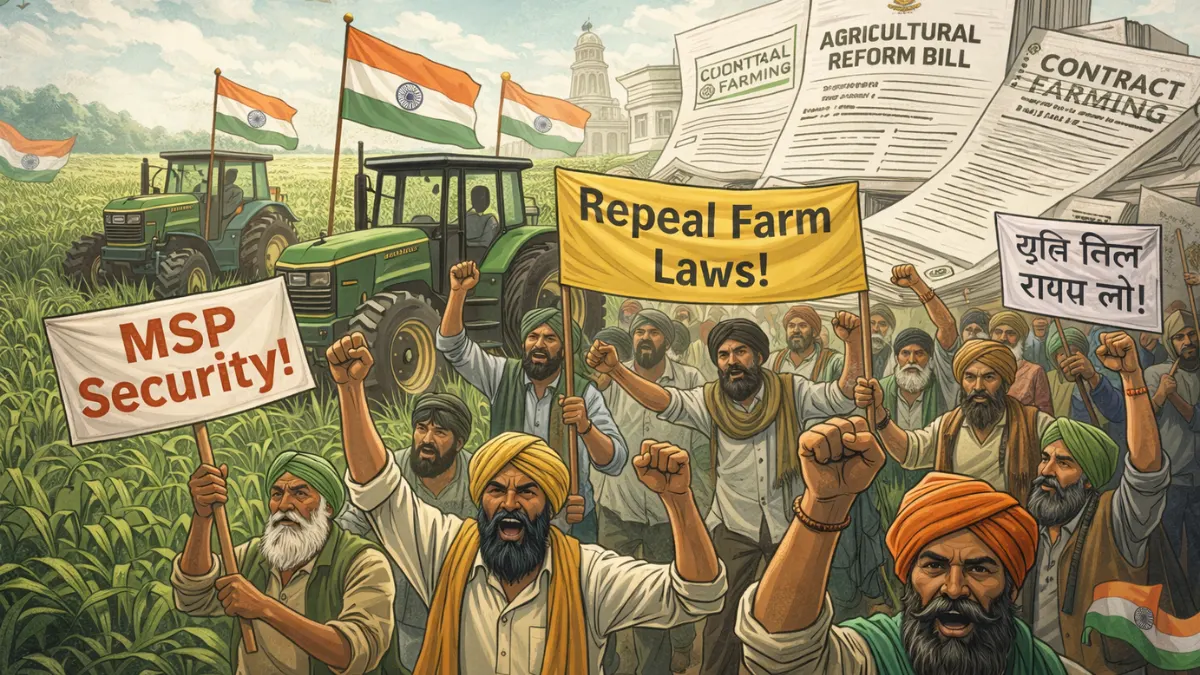
For many aspirants, questions on Agricultural Reform Policies after 2020 appear straightforward—until they attempt to structure an answer under exam pressure. The issue isn’t lack of knowledge. Most candidates are aware of the repeal of the farm laws India debate, the protests, and policy intent. The real challenge lies in converting scattered awareness into a coherent, scoring answer.
In GS papers, especially GS-III, agricultural reforms are not tested as static facts. They are evaluated as policy analysis. This is where most answers fall short.
Problem Statement
The most common mistake aspirants make while writing answers on Agricultural Reform Policies is treating them as current affairs summaries rather than analytical policy questions.
Typical issues include:
- Writing narrative-heavy answers (what happened) instead of analytical ones (why it matters)
- Ignoring stakeholder perspectives (farmers, government, markets)
- Lack of structure—answers become descriptive rather than evaluative
- No linkage with broader themes like federalism, market reforms, or MSP
The result: average answers that fail to stand out.
Concept Clarity
Agricultural Reform Policies: What the Examiner Actually Expects
When a question is framed around Agricultural Reform Policies, the examiner is not asking for a history of the 2020 farm laws. Instead, they expect:
- Understanding of reform intent (market liberalization, private participation)
- Awareness of implementation challenges (trust deficit, federal concerns)
- Ability to evaluate outcomes (policy success vs failure)
- Balanced conclusion (lessons, not opinions)
The 2020 farm laws debate serves as a case study—not the entire answer.

Core Concept Breakdown
You should approach agricultural reforms through three lenses:
- Economic Logic
- Market efficiency
- Price discovery
- Reduction of intermediaries
- Political Economy
- Farmer protests
- State vs Centre conflict
- Electoral considerations
- Institutional Capacity
- Implementation gaps
- Infrastructure limitations
- Regulatory oversight
Without this layered understanding, answers remain superficial.
Practical Framework
Step-by-Step Answer Writing Approach
When you see a question like:
“Discuss the lessons learned from Agricultural Reform Policies after 2020.”
Follow this structure:
Contextual Introduction (2–3 lines)
Mention the 2020 farm laws briefly and their repeal.
Reform Intent
Explain why reforms were introduced:
- Liberalizing agricultural markets
- Increasing farmer income
- Attracting private investment
Key Issues
Highlight challenges:
- Trust deficit with farmers
- Lack of consultation
- Federal concerns
Lessons Learned
This is the core scoring section:
- Need for stakeholder engagement
- Importance of phased implementation
- Role of states in agriculture
Way Forward
Suggest policy improvements:
- Strengthening MSP framework
- Building market infrastructure
- Institutional reforms
Balanced Conclusion
Avoid extreme positions.
Example Answer Structure (Model Snippet)
Question:
Discuss the lessons learned from Agricultural Reform Policies after 2020.
Answer (Short Format):
Agricultural reforms introduced in 2020 aimed at liberalizing farm markets and improving price realization. However, widespread protests and eventual repeal highlighted key policy gaps.
Firstly, reforms lacked adequate stakeholder consultation, leading to trust deficits among farmers. Secondly, agriculture being a state subject raised federal concerns, limiting acceptance. Thirdly, absence of institutional safeguards created fears regarding MSP and corporate dominance.
The primary lesson is that economic efficiency must be balanced with political feasibility. Future reforms should focus on consensus-building, phased implementation, and strengthening market infrastructure to ensure sustainable agricultural transformation.
Mistake vs Correct Approach
| Mistake | Correct Approach |
|---|---|
| Writing only about protests | Linking protests to policy design flaws |
| Ignoring MSP debate | Including MSP as a central concern |
| No structure | Clear intro-body-conclusion |
| One-sided answer | Balanced analysis |
Common Errors
Over-Focus on Events
Many answers become timelines of protests rather than policy analysis.
Lack of Keywords
Missing terms like:
- MSP
- APMC
- Contract farming
- Federalism
These are essential for GS scoring.
No Lessons Section
Candidates often forget that the question asks for “lessons,” not just issues.
Extreme Opinions
Statements like:
- “Reforms were completely wrong”
- “Farmers were misinformed”
Such positions reduce answer quality.
Ignoring Structure
Unstructured answers lose marks even if content is correct.
Tactical Application
Understanding Agricultural Reform Policies through this structured method directly improves marks in:
- GS Paper III (Agriculture, Economy)
- Essay Paper (Policy evaluation topics)
- Interview Stage (Opinion-based questions)
Why This Approach Works
- Converts static knowledge into analytical answers
- Demonstrates multidimensional thinking
- Improves clarity under time constraints
Examiners reward clarity, not volume.

Improvement Plan
Daily Practice (30–40 minutes)
- Pick one policy topic (e.g., MSP, irrigation, subsidies)
- Write a 150-word answer
- Focus on structure, not length
Weekly Plan
- Practice 2 full-length answers on agriculture
- Review model answers
- Identify missing dimensions
Monthly Strategy
- Revise agricultural topics:
- MSP
- APMC reforms
- Crop diversification
- Link them with current affairs
Internal Linking (Vue Times)
- [MSP Policy Analysis – Vue Times]
- [How to Write High-Scoring GS Answers – Vue Times]
- [India’s Agricultural Economy Structure – Vue Times]
[ruby_related heading=”More Read” total=5 layout=1 offset=5]
Conclusion
The debate around Agricultural Reform Policies after 2020 highlights a critical insight for aspirants: policy questions are not about recalling events but analyzing systems. The repeal of the farm laws India episode underscores the importance of stakeholder trust, federal balance, and institutional readiness.
For exam purposes, the lesson is equally clear—structured, balanced, and analytical answers consistently outperform descriptive ones.
Final Insight
At Vue Times, we focus on strategies that convert knowledge into marks. Master policy analysis, not just facts—because in competitive exams, structure decides success.
Frequently Asked Questions
What are Agricultural Reform Policies in India?
Agricultural Reform Policies refer to government initiatives aimed at improving market efficiency, farmer income, and agricultural productivity.
Why were the 2020 farm laws controversial?
They raised concerns about MSP security, corporate influence, and lack of consultation with farmers and states.
How should I write answers on farm laws India in UPSC?
Focus on structure: context, issues, lessons, and way forward rather than just describing events.
What keywords should be used in agriculture answers?
Include MSP, APMC, contract farming, federalism, and market reforms for better scoring.
How can I improve GS Paper III answers?
Practice structured writing, include multiple dimensions, and avoid narrative-heavy responses.