








Problem Statement
One of the most common mistakes among government exam aspirants is delaying answer writing until the final stages of preparation. Many students spend months reading textbooks, watching lectures, and collecting notes but avoid writing answers regularly.
This creates a significant gap between knowledge acquisition and exam performance.
Competitive examinations such as UPSC, State PCS, and other descriptive government exams require candidates to convert knowledge into structured written responses within strict time limits. Without Daily Answer Writing Practice, students often face the following problems:
- Slow writing speed during the exam
- Poor answer structure
- Difficulty prioritizing points
- Lack of clarity in introductions and conclusions
- Inability to complete the paper on time
Another major issue is the absence of a consistent exam routine strategy. Aspirants attempt answer writing randomly instead of integrating it into a structured daily study system.
For example, many candidates write answers only after completing an entire subject. This approach delays skill development and reduces opportunities for improvement before the actual exam.
The real challenge is not writing answers occasionally but building a disciplined daily writing system that improves speed, structure, and analytical clarity over time.
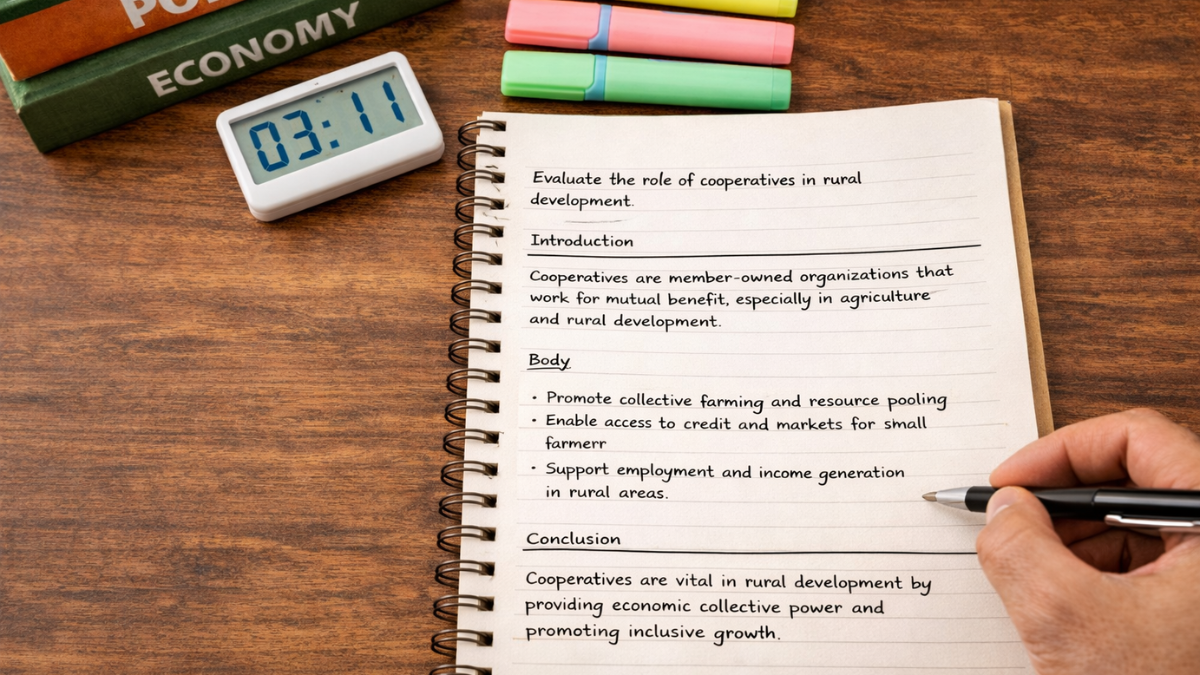
Concept Clarity
Daily Answer Writing Practice is a structured routine where aspirants write a fixed number of exam-style answers every day under controlled time conditions.
The objective is not merely writing more answers but developing three exam-critical skills:
- Answer Structure
- Content Prioritization
- Time Management
Unlike passive study methods such as reading or highlighting notes, answer writing forces the brain to recall information actively and organize it logically.
For descriptive exams, evaluation depends on how effectively an aspirant presents knowledge in a clear format. Examiners look for:
- Direct answers to the question
- Logical organization of ideas
- Relevant examples
- Balanced analysis
- Concise conclusions
Daily writing creates familiarity with the exam pattern, which reduces hesitation during the real exam.
A structured exam routine strategy integrates answer writing with revision and concept learning rather than treating it as a separate activity.
For example:
| Study Activity | Purpose |
| Reading subject material | Build conceptual knowledge |
| Answer writing | Convert knowledge into exam-ready responses |
| Review and feedback | Improve structure and clarity |
This integration ensures that preparation remains exam-oriented rather than information-oriented.
Practical Framework
Step-by-Step System for Daily Answer Writing
Building effective Daily Answer Writing Practice requires a structured framework rather than random question attempts.
Select Limited Questions Daily
Instead of writing many answers irregularly, focus on 3–5 high-quality answers per day.
Example structure:
| Type | Questions |
| Short answers (10 markers) | 2 |
| Long answers (15 markers) | 1–2 |
This balance prevents fatigue while maintaining consistency.
Use Timed Writing
Time discipline is critical.
Example time limits:
| Question Type | Time |
| 10 marker | 7 minutes |
| 15 marker | 11 minutes |
Strict timing trains the brain to process and organize information quickly.
Follow a Fixed Answer Structure
Every answer should follow a predictable structure.
Standard answer format:
- Introduction
- Core arguments
- Supporting examples
- Conclusion
This ensures clarity and scoring efficiency.
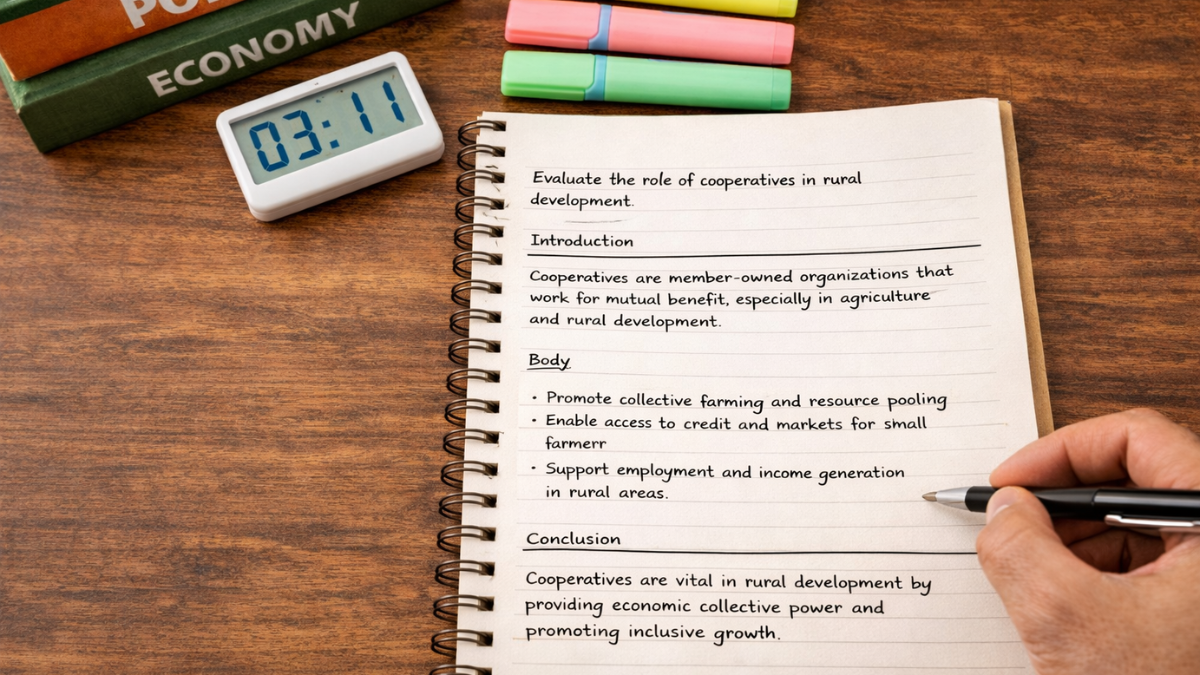
Model Answer Snippet
Question:
Explain the importance of decentralization in governance.
Introduction
Decentralization refers to the transfer of administrative and financial powers from central authorities to local institutions.
Body
- Improves administrative efficiency
- Strengthens local accountability
- Encourages participatory governance
- Enhances service delivery
Conclusion
Decentralization strengthens democratic governance by bringing decision-making closer to citizens.
This structure makes answers easier for examiners to evaluate.
Evaluate Immediately
After writing answers, perform a quick review.
Checklist:
- Is the introduction relevant?
- Are arguments logically ordered?
- Are keywords visible?
- Is the conclusion concise?
Self-review improves answer quality faster than passive reading.
Maintain an Answer Writing Log
Tracking progress is essential.
Example log:
| Date | Questions Written | Weak Areas |
| Day 1 | 3 | Weak introduction |
| Day 4 | 4 | Missing examples |
| Day 7 | 5 | Time management improved |
This transforms practice into measurable improvement.
Mistake vs Correct Approach
| Mistake | Correct Approach |
| Writing answers randomly | Follow daily question limit |
| No time tracking | Use strict time limits |
| Long introductions | Keep introductions concise |
| Ignoring structure | Use fixed format |
This comparison clarifies how disciplined writing improves exam performance.
Common Errors
Several mistakes prevent aspirants from benefiting from answer writing practice.
Writing Without Time Limits
Many aspirants write answers slowly while practicing.
This creates unrealistic preparation conditions.
Timed writing is essential for exam readiness.
Overwriting Answers
Students often write excessively long answers.
Examiners prefer clarity over length.
Example:
| Poor Approach | Effective Approach |
| 5 paragraphs without structure | Bullet points with clear arguments |
Ignoring Question Demand
Candidates sometimes write generic content without addressing the specific requirement of the question.
Example:
Question: Evaluate the role of cooperatives in rural development.
Incorrect response:
Explaining rural development broadly.
Correct response:
Analyzing the role of cooperatives specifically.
Lack of Daily Consistency
Many aspirants practice answer writing only on weekends.
Skill development requires consistent daily exposure.
No Feedback or Self-Review
Writing answers without evaluation limits improvement.
Aspirants must analyze structure, content, and time management after each session.
Tactical Application
Implementing Daily Answer Writing Practice improves exam performance in measurable ways.
Faster Recall
Writing answers daily trains the brain to retrieve information quickly.
This reduces thinking time during exams.
Structured Thinking
Regular writing encourages logical sequencing of ideas.
Example structure:
| Section | Content |
| Introduction | Definition or context |
| Body | Arguments with examples |
| Conclusion | Balanced summary |
This improves answer readability.
Better Time Management
Aspirants who practice timed writing are more likely to complete the entire paper.
Example comparison:
| Student Type | Answers Completed |
| No writing practice | 14 of 20 |
| Daily practice | 20 of 20 |
Completing the paper significantly increases total marks.
Clear Presentation
Examiners prefer answers that are:
- Structured
- Concise
- Direct
Daily writing develops presentation clarity.
Improvement Plan
A practical exam routine strategy should integrate answer writing into daily study schedules.
Daily Routine
Morning Session
- Study core subject material (2 hours)
Afternoon Session
- Write 3 answers based on studied topics
Evening Session
- Review answers
- Identify structural mistakes
Weekly Plan
| Day | Activity |
| Monday | Write 3 answers |
| Tuesday | Write 3 answers |
| Wednesday | Write 4 answers |
| Thursday | Write 3 answers |
| Friday | Write 4 answers |
| Saturday | Full-length answer writing session |
| Sunday | Review and improvement |
This routine maintains consistency without excessive workload.
Monthly Evaluation
Track progress using three indicators:
| Indicator | Target |
| Writing speed | Complete 15-marker within 11 minutes |
| Structure clarity | Clear introduction-body-conclusion |
| Answer completion | Finish all questions |
These indicators measure improvement objectively.
[ruby_related heading=”More Read” total=5 layout=1 offset=5]
Conclusion
Success in descriptive government exams depends on the ability to convert knowledge into structured written responses under time constraints. Reading textbooks and collecting notes alone cannot develop this skill.
A disciplined system of Daily Answer Writing Practice enables aspirants to improve speed, refine answer structure, and strengthen analytical clarity. When integrated with a consistent exam routine strategy, daily writing practice ensures that preparation remains aligned with actual exam requirements.
Over time, this structured approach builds familiarity with question patterns, reduces writing hesitation, and improves the ability to present arguments clearly. As a result, aspirants who follow consistent Daily Answer Writing Practice are better prepared to complete exam papers efficiently and maximize scoring potential.
Internal Linking (Placeholders)