








Problem Statement
One of the most common scoring gaps in descriptive government exams is the inability to properly use Current Affairs in Government Exams answers. Aspirants either:
- Write static, textbook-only responses.
- Overload answers with random current examples.
- Add unrelated schemes or data to “impress” the examiner.
- Mention news events without linking them to the question demand.
The result is weak answer relevance.
For example, in exams like the UPSC Civil Services Examination Mains or State PSC Mains, evaluators look for contextual depth. Static knowledge shows understanding. Current affairs show awareness. But without integration, both lose value.
The mistake is not lack of information. The mistake is lack of structured application.
Concept Clarity
What Does “Using Current Affairs” Actually Mean?
Using Current Affairs in Government Exams does not mean:
- Writing headlines.
- Listing recent schemes.
- Adding unrelated statistics.
- Turning answers into newspaper summaries.
It means:
Integrating recent developments to strengthen analytical depth, contextual accuracy, and answer relevance.
Current affairs should:
- Support your argument.
- Update static theory.
- Provide evidence.
- Improve analytical balance.
Static + Current = Scoring Answer
Every descriptive answer typically contains:
- Core concept (static syllabus)
- Application (real-world relevance)
- Critical analysis (evaluation)
- Way forward
Current affairs mainly strengthen:
- Application
- Evidence
- Way forward
Without them, answers appear outdated. With random usage, answers appear forced. Proper integration improves answer relevance.

Practical Framework
Step-by-Step Approach to Use Current Affairs
Decode the Question
Identify:
- Directive word (Discuss, Analyze, Critically Examine)
- Core theme
- Time frame (if mentioned)
- Dimensions required
Example Question:
“Discuss the challenges of urban governance in India.”
Static part: Structure of urban governance.
Dynamic part: Recent reforms, reports, schemes, case studies.
Identify Relevant Current Inputs
Use only 2–3 high-quality references such as:
- Recent government initiatives
- Supreme Court observations
- Data from Economic Survey
- NITI Aayog reports
- Major committee findings
Relevance filter:
Ask: Does this example directly strengthen my argument?
If no, exclude it.
Integrate — Don’t Isolate
Wrong approach:
“Recently, the government launched XYZ scheme.”
Correct approach:
“Weak fiscal autonomy of Urban Local Bodies remains a major challenge, as reflected in the limited success of schemes like XYZ, which faced funding and capacity constraints.”
Notice the integration into the argument.
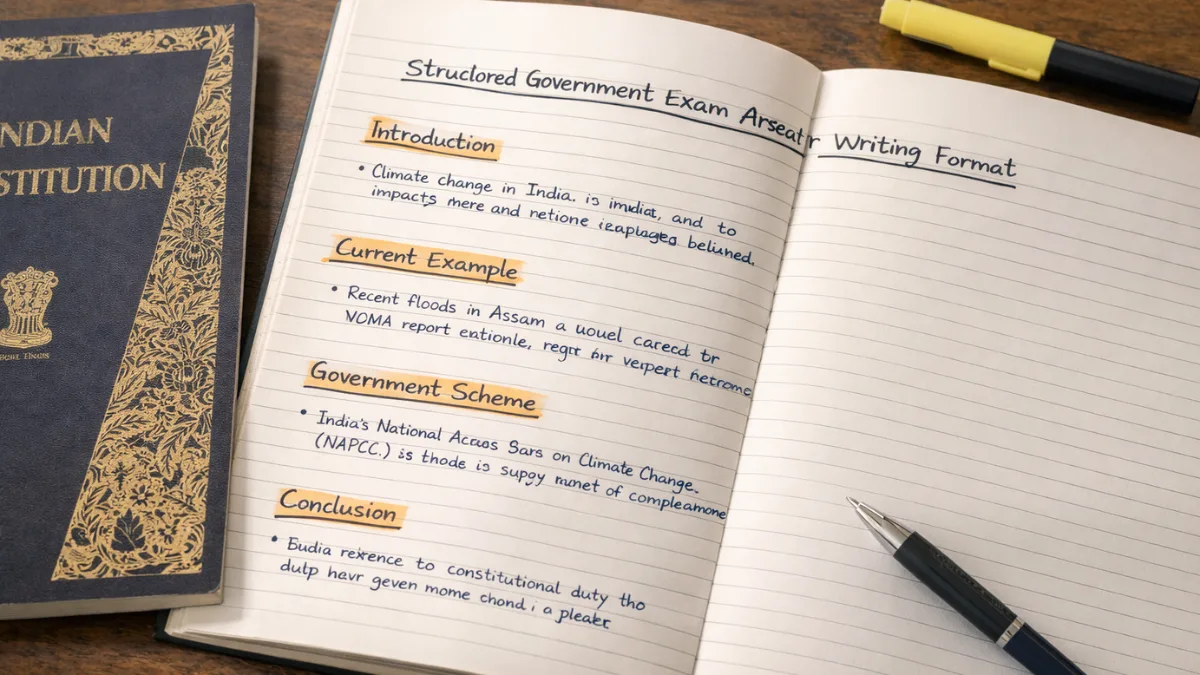
Example Answer Structure (10–15 Marker)
Introduction (2–3 lines)
Define the concept + one current context reference.
Body
- Structural Challenges (static explanation)
- Administrative Issues (add current report example)
- Financial Constraints (add recent data)
- Political Dimensions (if relevant)
Way Forward
- Link to ongoing reforms
- Reference a current policy push
Model Answer Snippet (Short Format)
Question: Examine the role of digital governance in improving service delivery.
Answer Snippet:
Digital governance enhances transparency, efficiency, and accessibility in public services. The expansion of platforms like Direct Benefit Transfer (DBT) has reduced leakages and improved targeting of subsidies. However, challenges such as digital exclusion and data privacy concerns persist. The increasing emphasis on digital public infrastructure reflects the government’s intent to institutionalize technology-driven governance, but addressing connectivity gaps remains essential for equitable service delivery.
This snippet shows:
- Concept clarity
- Current application
- Balanced view
- Answer relevance
No headline dumping. No random scheme listing.
Mistake vs Correct Approach Comparison
| Mistake | Correct Approach |
| Adding 5–6 schemes | Add 1–2 relevant schemes |
| Writing news summaries | Linking example to argument |
| Forcing current affairs in every paragraph | Using them strategically |
| Writing outdated theory only | Updating theory with current data |
| Using vague phrases like “recently government has taken steps” | Mentioning specific initiative with context |
Common Errors
Overcrowding the Answer
Aspirants assume more examples = more marks.
Reality: Examiners reward clarity and relevance, not volume.
Outdated Data
Using old census or irrelevant statistics reduces credibility. If unsure, avoid specific numbers.
Generic Current References
Statements like:
- “Government is taking steps.”
- “Various reforms have been introduced.”
These lack specificity and reduce answer relevance.
Misaligned Examples
Example:
Question: Agricultural reforms.
Answer includes: Space missions.
Irrelevant references weaken structure.
Ignoring Question Demand
For “critically examine”, students only list schemes without evaluating impact.
Current affairs must serve the directive word.
Tactical Application: How This Improves Marks
Using Current Affairs in Government Exams strategically improves scoring in four measurable ways:
Enhances Analytical Depth
Answers move beyond theory into real-world application.
Demonstrates Awareness
Shows the candidate understands ongoing developments.
Strengthens Answer Relevance
Each point appears connected to contemporary governance realities.
Improves Introduction and Conclusion Quality
A relevant current hook makes introductions sharper.
Example:
Instead of:
Climate change is a global issue.
Write:
The increasing frequency of extreme weather events in recent years highlights the urgency of addressing climate change.
Specific. Contextual. Relevant.
Improvement Plan
Daily Execution Strategy
Issue-Based Notes (30 minutes daily)
Convert news into issue-based folders:
- Economy
- Governance
- Environment
- Social Justice
Avoid event-based notes.
Point Extraction Rule
For every major news item, extract:
- What is the issue?
- Why is it important?
- Where can I use this in answers?
If you cannot answer question 3, do not store it.
Weekly Integration Practice
Once a week:
- Take 5 previous year questions.
- Add 2 relevant current references in each.
- Rewrite introductions using current hooks.
Static + Current Mapping Sheet
Maintain a two-column notebook:
| Static Topic | Current Link |
| Federalism | Recent GST Council developments |
| Health | Public health reforms |
| Agriculture | MSP policy debates |
This improves recall speed during exams.
Internal Link Placeholders
- [How to Improve Answer Structure in Mains Exams]
- [Directive Words Strategy for Government Exams]
- [Common Mistakes in Government Exam Answer Writing]
[ruby_related heading=”More Read” total=5 layout=1 offset=5]
Conclusion
Using Current Affairs in Government Exams is not about inserting news headlines into answers. It is about strengthening answer relevance through structured integration of contemporary developments into static concepts.
When used strategically:
- They sharpen introductions.
- Deepen analysis.
- Improve balance.
- Increase scoring precision.
Aspirants who systematically map static syllabus topics with dynamic updates consistently produce higher-quality, context-rich answers. The key is disciplined selection, proper integration, and maintaining answer relevance in every paragraph.
In descriptive government exams, current affairs are not decoration. They are reinforcement tools. When applied through a structured framework, Current Affairs in Government Exams become a scoring differentiator rather than a superficial addition