








Descriptive government examinations test both knowledge and execution. Candidates often know the content but struggle to complete the paper within the allotted time. This issue is primarily related to Writing Speed Government Exams preparation. When writing speed is slow, answers remain incomplete. When candidates try to write faster without structure, answer clarity decreases and examiners find it difficult to evaluate responses effectively.
A balanced approach is required. Writing quickly is useful only when the answer remains structured, relevant, and analytically clear. Therefore, improving Writing Speed Government Exams preparation is not about writing more words. It is about producing clear, structured responses within strict time limits.
This article explains a practical framework to improve writing speed without losing analytical depth. The focus remains on practical answer-writing execution used in government exams.

Problem Statement
Many aspirants preparing for descriptive government exams face the same problem during mock tests: incomplete answers or rushed final responses. This occurs because candidates misjudge how much time structured answers actually require.
Several preparation mistakes contribute to slow answer writing.
Overly lengthy introductions
Some candidates begin answers with long conceptual explanations. While introductions should provide context, unnecessary theoretical explanations consume valuable time.
No structured thinking before writing
Candidates often start writing immediately after reading the question. Without planning, they revise sentences mid-answer or repeat similar points.
Paragraph-only answers
Long paragraphs slow writing speed and reduce answer clarity. Bullet points and subheadings allow faster expression of ideas.
Excessive rewriting
When answers lack structure, candidates frequently modify sentences during writing. This significantly reduces writing speed.
Inefficient time allocation
Aspirants may spend too much time on the first few questions, leaving insufficient time for the remaining ones.
These challenges demonstrate that writing speed is not only a handwriting issue. It is a strategy problem involving planning, structure, and clarity.
Concept Clarity: Understanding Writing Speed Government Exams
Improving writing speed requires understanding how examiners evaluate descriptive answers.
Government exam evaluators prioritize:
- Relevance to the question
- Logical structure
- Clear arguments
- Balanced conclusions
They do not reward excessive word count. Instead, answers that demonstrate clear reasoning and structured presentation receive higher marks.
Key Principle
Speed improves when the writing process becomes structured and predictable.
Instead of thinking while writing, candidates should follow a pre-defined answer framework.
This approach produces three advantages:
- Faster answer construction
- Improved answer clarity
- Reduced editing during writing
Ideal Time Allocation Example
For a typical descriptive paper:
| Question Marks | Ideal Writing Time |
| 10 Marks | 7 minutes |
| 15 Marks | 10 minutes |
| 20 Marks | 12–14 minutes |
Candidates who exceed this time limit usually fail to complete the paper.
A structured Writing Speed Government Exams strategy ensures answers remain concise while maintaining analytical depth.
Practical Framework to Improve Writing Speed
Improving writing speed requires a repeatable method that works during exams.
Below is a practical framework used during mains-level descriptive exams.
Rapid Question Analysis (30 Seconds)
Before writing, identify three elements:
- Core topic
- Directive keyword (discuss, analyze, evaluate)
- Required dimensions
Example:
Question:
“Discuss the role of transparency in public administration.”
Dimensions could include:
- Governance accountability
- Public trust
- Corruption prevention
This short analysis prevents irrelevant writing.
Create a Micro Outline (30–40 Seconds)
Write quick keywords before starting.
Example outline:
Introduction – governance transparency definition
Body – accountability, citizen trust, corruption reduction
Conclusion – ethical governance
This step reduces thinking time during writing.
Use Structured Headings
Instead of long paragraphs, divide answers into sections.
Example:
Introduction
Key Dimensions
Administrative Impact
Challenges
Conclusion
Structured writing improves both speed and answer clarity.
Use Bullet Points for Arguments
Bullets allow faster writing compared to long narrative paragraphs.
Example:
Transparency improves governance through:
- Improved public accountability
- Reduced administrative corruption
- Increased citizen trust
- Better policy monitoring
Bullet points also help examiners scan answers quickly.
Limit Introduction Length
An effective introduction should contain two to three lines only.
Example:
Transparency in governance refers to open decision-making processes that allow citizens to access information about public administration. It strengthens accountability and improves institutional trust.
Avoid long conceptual discussions.
Write a Focused Conclusion
Conclusions should reinforce the core concept rather than introduce new arguments.
Example:
Transparent governance strengthens democratic accountability and promotes responsible public administration.
A concise conclusion saves time while maintaining answer completeness.
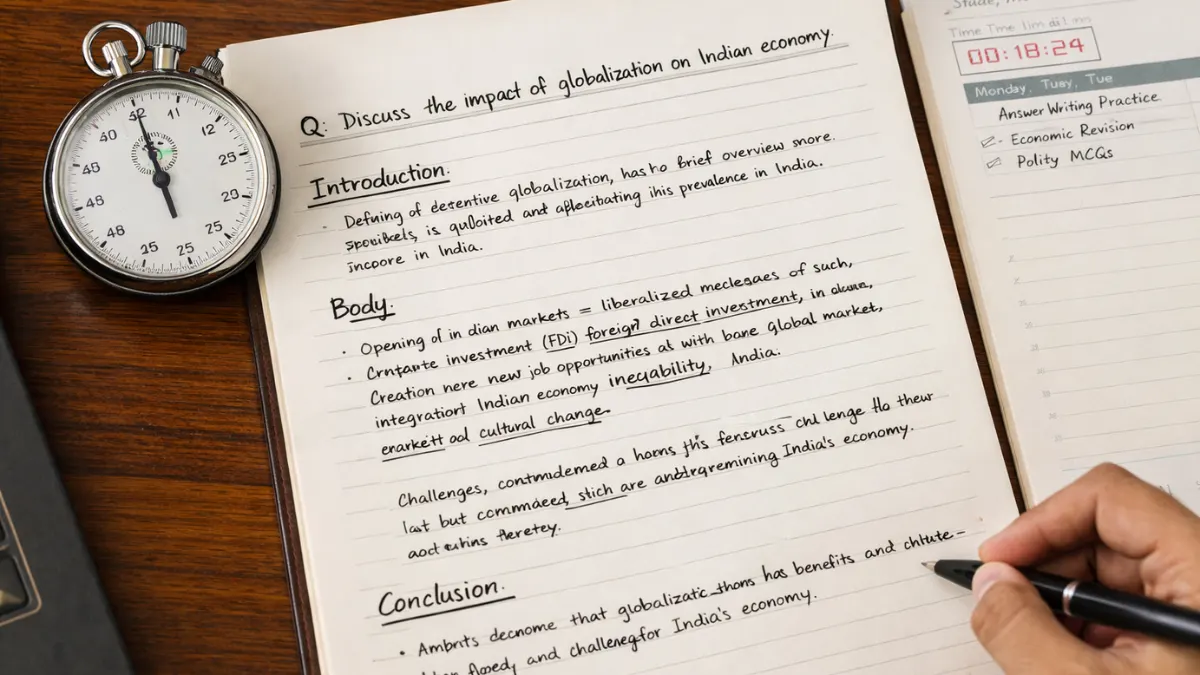
Example Answer Structure
This format balances writing speed and analytical depth.
Introduction
Brief definition or context.
Core Arguments
- Argument 1
- Argument 2
- Argument 3
Administrative Impact
- Governance improvement
- Citizen engagement
Conclusion
Summarize the principle or governance value.
This format can be used across most descriptive government exam questions.
Model Answer Snippet
Question:
Explain the importance of accountability in public administration.
Short Model Answer
Introduction:
Accountability in public administration refers to the responsibility of government officials to justify their decisions and actions to the public and oversight institutions.
Importance:
- Ensures responsible use of public resources
- Prevents corruption and misuse of authority
- Strengthens citizen trust in institutions
- Improves policy implementation
Conclusion:
Strong accountability mechanisms create transparent and efficient governance systems.
This structured answer maintains answer clarity while allowing faster writing.
Mistake vs Correct Approach
| Mistake | Correct Approach |
| Writing long theoretical introductions | Use concise two-line introductions |
| Paragraph-heavy writing | Use bullet points and headings |
| Thinking while writing | Create micro-outline first |
| Overwriting explanations | Focus on key arguments |
| Unstructured conclusions | Write short analytical conclusion |
This comparison highlights how structured writing increases speed without reducing depth.
Common Errors in Writing Speed Preparation
Even experienced aspirants repeat several mistakes during answer writing.
Writing excessive content
Candidates assume longer answers receive higher marks. In reality, examiners prioritize relevance and clarity.
Ignoring answer structure
Unstructured writing forces candidates to constantly rethink content while writing.
Attempting perfect sentences
Trying to produce perfect academic language slows writing speed. Clear, simple sentences work better.
Not practicing under timed conditions
Many aspirants practice answer writing without timing themselves. This creates unrealistic expectations about exam performance.
Weak handwriting discipline
Poor handwriting leads to slower writing and reduced readability.
Simple improvements such as consistent letter size and spacing can improve writing flow.
Tactical Application: How Writing Speed Improves Marks
Improving Writing Speed Government Exams preparation directly affects scoring.
Complete answers receive higher marks
Incomplete answers automatically reduce scores. Faster writing ensures all questions are attempted.
Structured responses improve evaluation
Clear headings and bullet points make answers easier for examiners to evaluate.
Balanced coverage of questions
Improved writing speed ensures equal attention to all questions.
Improved answer clarity
Structured writing reduces confusion and improves logical flow.
Reduced exam stress
A candidate who follows a structured writing process spends less time thinking during the exam.
Improvement Plan for Writing Speed
Improving writing speed requires consistent practice.
Daily Practice (30 Minutes)
Task 1: Outline Practice
Take one previous exam question.
Write a 30-second outline without writing the full answer.
This builds rapid thinking ability.
Task 2: Timed Answer Writing
Write one 10-mark answer in 7 minutes.
Focus on:
- Structured headings
- Bullet points
- Short introduction
Task 3: Clarity Check
After writing, verify:
- Is the answer structured?
- Are points concise?
- Does the conclusion summarize the argument?
Weekly Practice Plan
Day 1–2
Write three short answers under strict time limits.
Day 3
Practice structured outlines for five questions.
Day 4–5
Write one mini mock test.
Day 6
Evaluate answers and identify slow writing areas.
Day 7
Rewrite one answer focusing on structure and clarity.
Self-Evaluation Questions
Ask yourself:
- Did I exceed the time limit?
- Did I include unnecessary explanations?
- Was the answer easy to read?
This review process gradually improves writing efficiency.
Internal Linking Opportunities
Answer Writing Strategy for Government Exams
Self-Evaluation Method for Government Exams Preparation
Common Answer Writing Mistakes in Government Exams
[ruby_related heading=”More Read” total=5 layout=1 offset=5]
Conclusion
Descriptive government examinations reward candidates who combine knowledge with efficient writing execution. Slow writing often results from poor planning, unstructured responses, and unnecessary explanations rather than lack of knowledge.
A practical Writing Speed Government Exams strategy focuses on quick question analysis, micro-outlines, structured headings, and concise bullet-point arguments. These techniques allow candidates to maintain analytical depth while completing answers within strict time limits.
By practicing structured answer formats and timed writing sessions regularly, aspirants can improve both writing efficiency and answer clarity. Consistent implementation of this approach ensures that candidates present clear, complete, and evaluable answers during the exam. A disciplined Writing Speed Government Exams preparation strategy ultimately transforms answer writing into a predictable and efficient process.